Visiting the Crash Site

This is the seventh post in a series about my experience in the immediate aftermath of the Flight 5342 tragedy (part one: The Night It Happened). Revisiting this period is helpful to me, but reading about it may not be helpful to you. Feel free to skip this one if you might find it upsetting.
During our daily NTSB briefings, there were two numbers that were more important to us than any other information we would receive: the number of people recovered and the number of people identified.
On February 1, 2025, the day after the first briefing I attended, the numbers did not change materially. The recovery team was waiting on some additional salvage equipment to arrive, which was expected to expedite the recovery of the remaining passengers and crew members.
But we did receive one big piece of news at this briefing: there would be an optional opportunity to visit the crash site the following morning.
Throughout the experience up to that point, I had found that knowing details, however difficult, was proving better for me than letting my imagination go to work. So it didn’t take much deliberation to decide that I would go to the site. My sister, Amanda, decided that she would accompany me.
The following morning, we made our way to the hotel lobby and congregated with other family members who would be joining us on the journey. I knew of some people who chose not to go, but a surprisingly large number had decided to attend.
We boarded a convoy of coach buses in front of the hotel. Our route took us through some quiet suburban areas of Maryland, which eventually gave way to highways and office buildings of northern Virginia. I remember passing buildings I had visited on business trips. Those days felt like a different life — “important” meetings that felt meaningless compared to what I was experiencing now.
When we reached the airport, our buses entered through a gate and traveled a route that ended at Runway 33 — the runway that Flight 5342 was approaching when the collision occurred.
We all disembarked and walked farther toward the end of the runway. There was a rustic memorial — hay bales, flowers, a wreath — and a color guard with representatives from the organizations involved in the response.
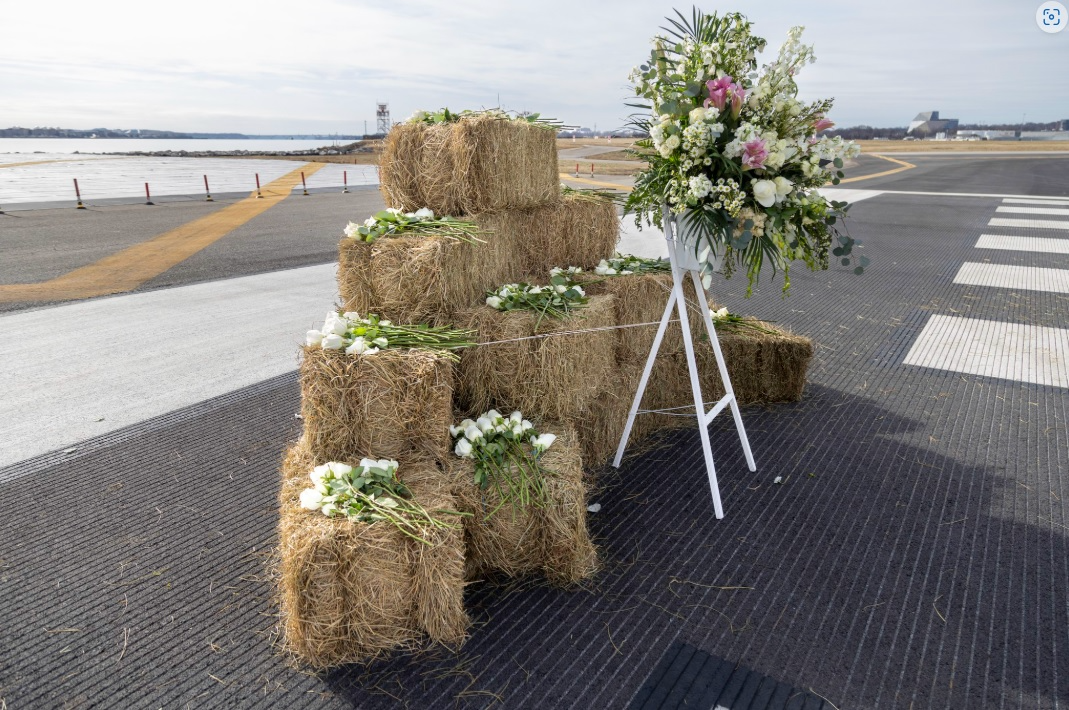
As we stood on Runway 33, a steady stream of flights took off and landed on the more widely used Runway 1. More than half were American flights, including many regional jets that looked just like Flight 5342.
I would later discover that one of these regional jets, American Eagle Flight 5363, went wheels up at 10:14 a.m. en route to Providence, R.I. — the path of the connecting flight that Christine and Spencer never made.
The crash site itself was not the loud, chaotic, frigid, and icy hellscape that my mind’s eye had been showing me for days. It was peaceful. While it was a cool February morning, the sun shone brightly toward us from behind the wreckage and reflected off the calm waters of the Potomac.
I took great comfort in seeing a stationary rescue boat standing post next to the wreckage. If anyone was still down there, they were not alone.
Being there drove home for me just how close Christine and Spencer were to being on the ground. The wreckage was not far from the end of the runway, and I knew from the briefings that the collision occurred just a few hundred feet above the water.
They were at the point in the flight where you look out the window, see the airport approaching, and think, “I made it safely.”
Turning 180 degrees brought another realization: the air traffic control tower was right there. This was not a case where a far-off blip disappeared on a radar screen. The collision occurred directly in front of them.
After a brief ceremony, the color guard brought the wreath to a waiting rescue boat. The boat then began a slow and methodical voyage to the wreckage, navigating around the shallow spots discovered through days of search and recovery activities.
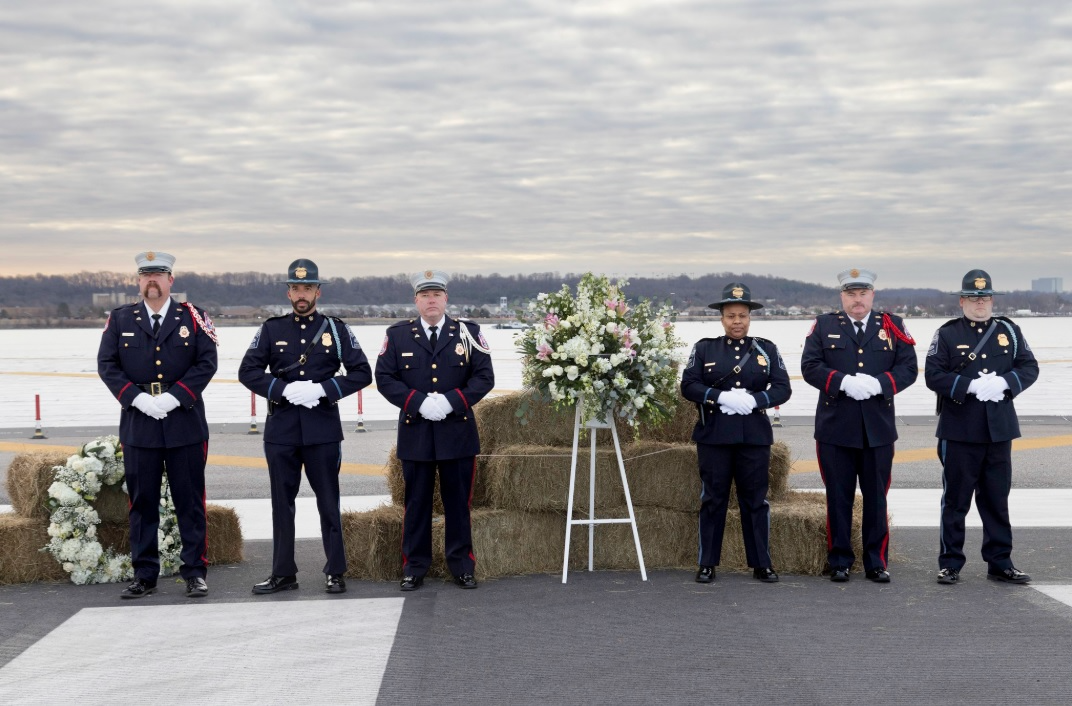
As counterintuitive as it seems, I felt more at peace at the crash site than I had all week. I have been back to Reagan National and the surrounding areas numerous times since then. Each visit brings me more comfort than distress.
It’s the last place they were — the doorway between life as it was and life as it is now. The door is closed, and I can’t open it.
But standing close to it makes me feel close to them.
If you found this interesting or moving, consider making a donation to the Christine Conrad Lane Memorial Dog Park. My wife Christine was a lifelong dog lover and dedicated volunteer for a local dog rescue nonprofit, Rhode Home Rescue.