A Quiet Death

This is the seventh post in a series on the two-decade resistance to ADS-B In, the technology the NTSB says would have prevented the Flight 5342 collision (part one: The Original Sin).
When I last left you, Congress had passed a law in 2012 that directed the FAA to begin a rulemaking requiring ADS-B In — the technology that helps pilots see and avoid aircraft on a collision course — on aircraft in busy airspace by 2020.
Almost 14 years to the day after this law was passed, on February 12, 2026, NTSB Chairwoman Jennifer Homendy testified to the Senate Commerce Committee that if both aircraft had been equipped with ADS-B In on January 29, 2025, the Flight 5342 collision would not have happened.
So why wasn’t ADS-B In installed on Flight 5342 that night in 2025 if Congress had required it by 2020?
Well, the FAA responded to the passage of the 2012 law in a familiar way: by putting the aviation lobbyist bat signal back up.
Rather than forming a new rulemaking committee, they extended the charter of the existing ADS-B In rulemaking committee. This is the same committee that was co-chaired by aviation industry lobbying groups and had already recommended against an ADS-B In mandate. You know, the gang that only considered the impact of pilot situational awareness on airlines’ bottom line — not safety — when recommending whether ADS-B In should be required.
And before they even had a chance to run Play 4 (Define the decision criteria on your terms) again, the FAA ran it for them. They directed the committee to determine “how to frame an ADS-B In equipage mandate such that the benefits exceed costs before 2035.”
Do you think the industry-led committee approached its work with an “I think I can” or an “I think I can’t” mindset?
It didn’t take long for that answer to be revealed.
In October 2012, the committee’s answer to the FAA concluded that “there is not yet a compelling business case” and that “any ADS-B In required equipage is unachievable by 2020.”
OK, but surely the committee had a counterproposal for when ADS-B In equipage would be achievable, right?
Nope.
The committee noted that the FAA “will lack the necessary elements to contemplate or justify proposal of an ADS-B In equipage rule for an extended period of time.” For good measure, it asked Congress to pay for the work that would tell the airlines whether a mandate was worth their while. Remember Play 2 (Never miss an opportunity to buy time), after all.
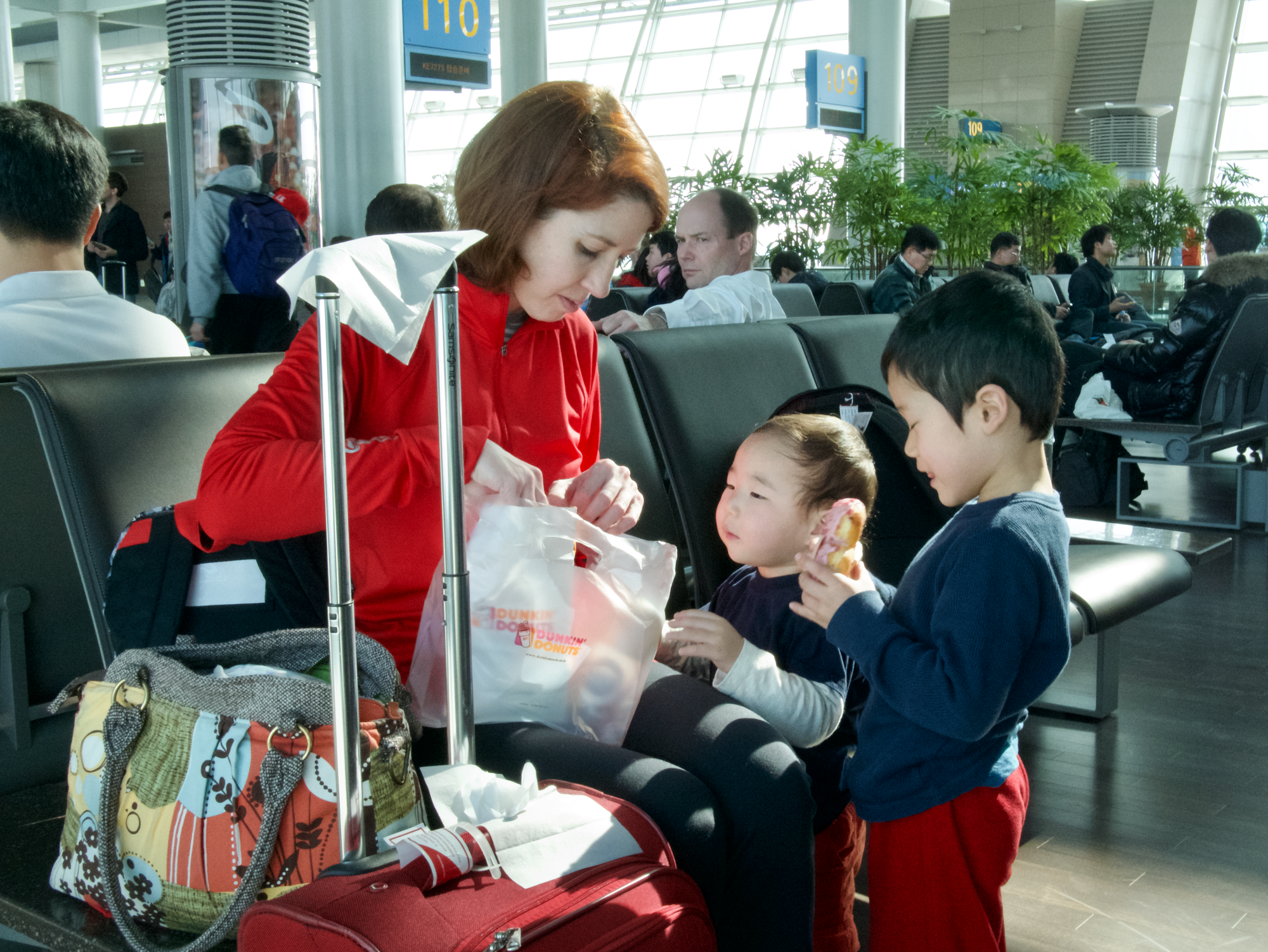
A couple of years after ADS-B In equipage by 2020 was written into law, our family of three became a family of four. Christine, Spencer, and I had traveled to Seoul to meet Milo during the week of Christmas 2013, and we returned the following February to complete the process and bring him home.
We spent some time exploring the sights of Seoul as a family, and Spencer and Milo bonded over bed jumping and the play area at our hotel.

On February 14, 2014 — two years to the day after the ADS-B In mandate was signed into law — we got a jump on introducing Milo to life as a New Englander with his first Dunkin’ Donuts before boarding our flight from South Korea to the United States.
About four months later, on June 17, 2014, RTCA, the industry group that the FAA delegates technical standards development to, released DO-317B, which set clear standards for using ADS-B In to display traffic and alert pilots.
That same year, the FAA revisited the issue. But they gave themselves and the merry band of industry lobbyists they rely on to write the rules a generous four years, until 2018, to propose an ADS-B In rule, with a final rule to follow in 2022. This would have put the starting line for the industry two years after the finish line that Congress wrote into law.
But between the standards being set in 2014 and the FAA’s 2018 deadline for a proposed rule, a whole lot of nothing happened besides — I can only assume — continued industry lobbying against an ADS-B In mandate.
The years 2015, 2016, and 2017 came and went without a proposed ADS-B In rule.
By 2018, aviation industry special interests had successfully bought a decade of delay since the 2008 letters from the NTSB and Air Line Pilots Association highlighting the safety importance of ADS-B In. But now the clock was running out. The FAA’s deadline for a proposed rule was fast approaching, and there was also the small matter of the 2012 law still on the books requiring ADS-B In equipage by 2020.
It was time for Play 6 (Have a lobbyist call in a favor).
The House version of the next big FAA reauthorization bill was introduced on April 13, 2018. As it went through the Rules Committee, 49 amendments were made in order. Amendment 1 was offered by Rep. Bill Shuster (R-Pa.). Shuster was then chairman of the House Transportation and Infrastructure Committee, making him the most influential member of the House when it came to this bill.
Chairman Shuster’s Amendment 1 was summarized in the Rules Committee report as follows:
Shuster (PA): Improves aviation safety by addressing issues such as airline engines, air ambulances, certification processes, and airspace operations. Adjusts FAA authorization levels to conform with updated CBO baseline for FY 2018. Makes counter-UAS systems AIP eligible. Continues the contract weather observer program and requires the Secretary to define the roles and responsibilities of the FAA Tech Center. Reforms and provides transparency to FAA organization and programs. Addresses consumer concerns, including sexual misconduct on flights, treatment of passengers with disabilities, and harmonization of service animal standards. Improves the Airport Investment Partnership Program. (10 minutes)
Sounds pretty great, right?
The only problem is that if you read the full text of Amendment 1, you’ll find the following about 80 percent of the way into the 8,600-word document:
Section 211(b) of the FAA Modernization and Reform Act (49 U.S.C. 40101 note) is repealed. The Administrator of the Federal Aviation Administration shall ensure that any regulation issued pursuant to such subsection has no force or effect.
Any guesses on what is in Section 211(b) of the FAA Modernization and Reform Act?
That’s right: the statutory requirement that aircraft in busy airspace be equipped with ADS-B In by 2020.
The two-sentence repeal got exactly two sentences of floor discussion. Introducing his amendment on April 26, 2018, Chairman Shuster framed it as “some good government reforms,” telling the House that “the amendment repeals a costly mandate for aircraft avionics that have not yet proven to be beneficial. This will relieve a future burden on aircraft operators.” No one mentioned ADS-B, or the idea of keeping airplanes from colliding in midair.
This language stayed neatly tucked away as the House and Senate worked through the final bill text. Eventually, the bill passed with strong bipartisan support in both the House and Senate. I suspect that very few members of Congress who voted for the bill had read the 49 words pertaining to ADS-B In hidden in the 187,587-word bill or understood their implications.
On October 5, 2018, President Trump signed the FAA Reauthorization Act of 2018 into law. And just like that, the 2020 ADS-B In mandate died a quiet death.
I can’t say with certainty where Chairman Shuster’s heartfelt concern for the burdens on aircraft operators came from.
But astute readers of this newsletter may remember him from “Barriers to Barriers” as the guy who stiff-armed a 9/11 widow, received the maximum allowable contribution from the political action committee of Airlines for America, the airlines’ lobbying organization, in every election cycle of his chairmanship, and dated an Airlines for America lobbyist while chairing the House committee that oversees the industry.
Ninety days after the FAA Reauthorization Act of 2018 became law, Chairman Shuster retired from Congress. About a month later, he joined Squire Patton Boggs, one of the largest and best-known lobbying firms in the world. Among the clients he now lobbies for is, you guessed it, Airlines for America.
Powerful lobbying groups, sympathetic elected officials, and a deferential FAA have shielded the airlines from the “burden” of ADS-B In for nearly two decades — longer than Spencer was alive.
And they’re still doing it even though 67 people are dead and the NTSB chairwoman said ADS-B In would have saved them.
If you found this interesting or moving, consider making a donation to the Christine Conrad Lane Memorial Dog Park. My wife Christine was a lifelong dog lover and dedicated volunteer for a local dog rescue nonprofit, Rhode Home Rescue.