Finding Competence and Compassion (Part 2)
This is the fifth post in a series about my experience in the immediate aftermath of the Flight 5342 tragedy (part one: The Night It Happened). Revisiting this period is helpful to me, but reading about it may not be helpful to you. Feel free to skip this one if you might find it upsetting.
After completing our initial interview with the team from the D.C. Office of the Chief Medical Examiner, Amanda and I went back into waiting mode for a bit. The hotel meeting room where we started the day became our informal home base, but we also walked around the other areas and met more family members. And because there were six passengers from the Skating Club of Boston on the flight, I also began running into familiar faces.
It was surreal to see people I know from an entirely different physical and emotional context there with me in Bethesda. Seeing them felt good and bad simultaneously.
Just as I had the impulse to text Spencer from the train, I found myself reaching for my phone to send Christine little updates, as I normally would when traveling.
“You’ll never believe who I ran into at my hotel in D.C.”
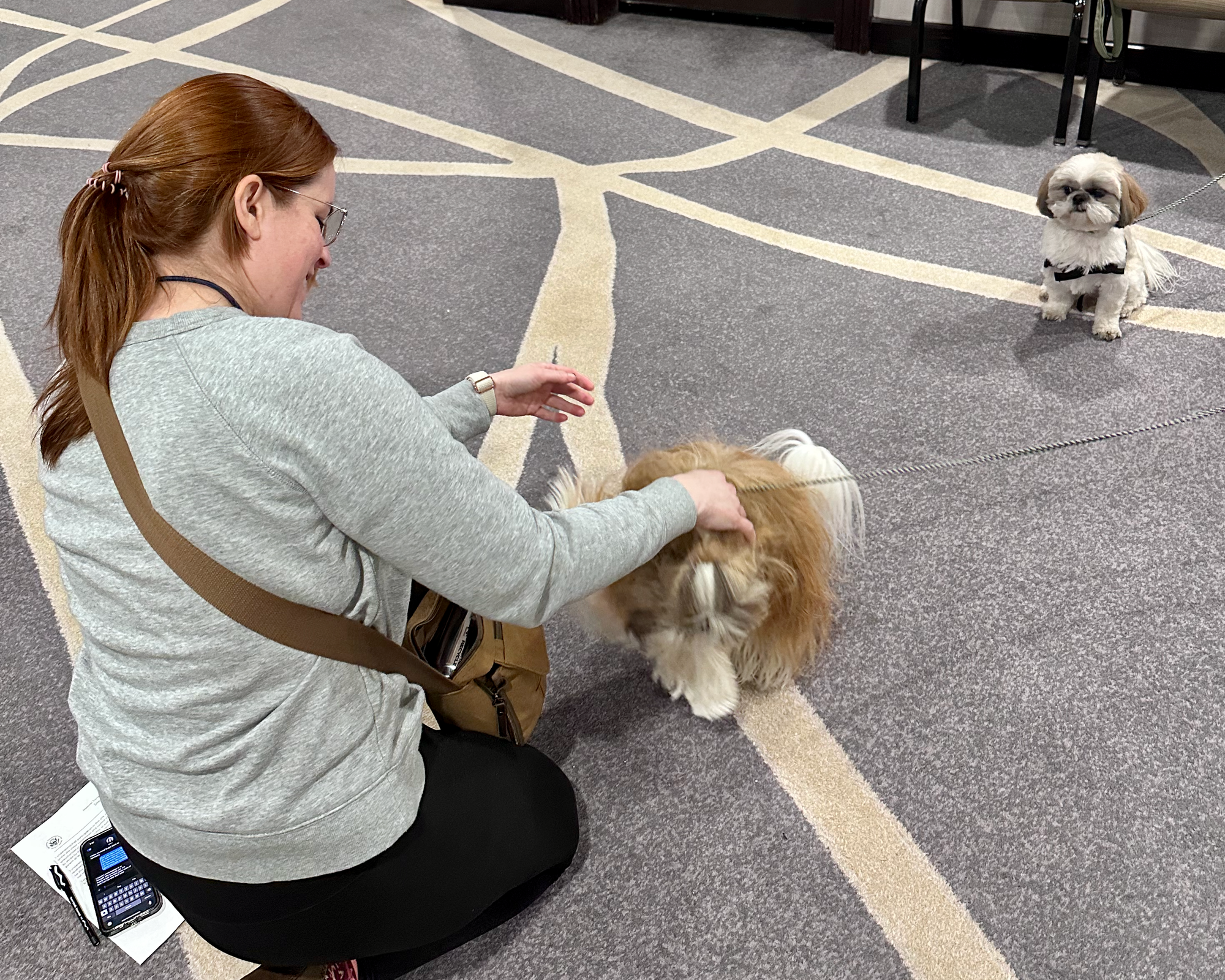
“Look at the cute comfort dogs they have here.”
I was in this strange place where I knew she was gone, but the muscle memory of being in near-constant contact with someone for a quarter of a century hadn’t yet given an inch.
Eventually, one of the NTSB staff members made the rounds to let everyone know that a family briefing would be held in the afternoon in a room on the top level of the hotel.
As the appointed time approached, family members made their way up the elevators to a large ballroom configured with a podium and chairs. I’m not sure exactly how many friends and family eventually filled the room, but it was likely in the hundreds.
While the NTSB ran the briefing, they pulled in leaders from the agencies involved in the response, such as D.C. Fire and EMS and the chief medical examiner, Dr. Francisco Diaz — Kathy’s boss.
We learned that 41 of 67 bodies had already been recovered, including 28 that had been positively identified. The team expressed high confidence that all 67 would be recovered over the next several days.
Senior officials from the NTSB and the other responding agencies attended the briefings in person. In addition to delivering updates, they expressed real emotion. This was more than a job for them, and some even had their own personal connections to the tragedy.
But I’ve also been around large organizations enough to know that behind every leader are the unsung heroes who live in the details and get things done. Kathy clearly played that role for Dr. Diaz.
And during this and future briefings, I found the other beacon that would guide me through the week: Elias, the leader of the NTSB’s Transportation Disaster Assistance team.
The briefing we attended on January 31, 2025, was the first of a series of daily briefings that would occur in Bethesda that week. Each time, when the agency leaders finished their updates and moved on to briefing the media and public, Elias would take the mic, brief us on some of the finer details of the recovery effort and NTSB investigation, and answer any question we threw at him.
And we threw many at him.
These briefings often continued for hours. Many of the questions from friends and family were quite intelligent and constructive. There were people in the room from all walks of life, including some with military and/or aviation experience. There were also people like me, who knew very little about aviation but came from fields like technology where general concepts applied. But some of our questions were, admittedly, just expressions of emotion wrapped in question form or grasping at straws to try to make sense of how this could have possibly happened.
Regardless of which of these buckets a question came from, Elias considered it thoroughly and respectfully and provided the best answer he could.
If I had ever tried to imagine myself in a situation like this, what I would have expected is for an organization like the NTSB to assign a “people person” — high on emotional intelligence but perhaps limited in subject-matter expertise — to brief the family members. They would say a lot of words without really saying much and take action items to go talk to the experts when a detailed question was asked. A pat on the head to keep us calm while the experts did the real work away from our eyes.
This wasn’t how it worked with Elias.
Elias is himself a pilot and flight instructor, and he was clearly well-briefed on all aspects of the investigation. There were very few questions he couldn’t just answer directly in the moment. If there were ever any he wasn’t sure of, he would often say what he thought the answer was with the caveat that he would verify with other members of his team and confirm the next day. And he always followed through.
Like Kathy from the medical examiner’s office, Elias projected a perfect blend of competence, kindness, and humility. This instilled early confidence that the NTSB was up to the task and would do right by Christine and Spencer.
As I look back on my notes from these briefings during our week in Bethesda, it’s remarkable how much detailed and relevant information we received in those early days — and how accurate it all proved to be. We were treated like adults and given the facts as they became available.
During these daily Q&A sessions with Elias, we were diving into the weeds at a level that was kind of ludicrous in retrospect — a room full of amateur investigators with half-working brains thinking we were going to be the ones to crack the case. I’m sure Elias recognized the absurdity of it even as it was happening.
But I really needed it. I’m sure other family members did too.
Trying to put the pieces of the puzzle together and dutifully typing up text updates to friends and family back home gave me something to focus on while the recovery and identification process progressed.
Sometime around 4 p.m. on January 31, as our first marathon Q&A session with Elias continued, I received a phone call from an unfamiliar number. I let it go to voicemail, but when I looked at the transcription on my iPhone, I saw the words I’d been waiting for: “American Airlines care team.”
I stepped out into the hallway and returned the call. On the other end was a man named Tom, who explained that he and his colleague Tracy were on site at the hotel and would be dedicated to helping my family.
Forty-three hours after the collision, American Airlines finally acknowledged my existence and offered to help.
If you found this interesting or moving, consider making a donation to the Christine Conrad Lane Memorial Dog Park. My wife Christine was a lifelong dog lover and dedicated volunteer for a local dog rescue nonprofit, Rhode Home Rescue.